

Introducing the Handbook for Relational Needs-Based Organising
Written by Joel Lazarus
I am the lead author for the recently published Handbook for Relational Needs-Based Organising. I wrote it together with fellow Rhizomista Maria Franchi alongside Neil Howard and John Michael for international NGO Terre des hommes, an organisation working for and with children to defend and extend their rights.
The Handbook juxtaposes what we see as the mainstream, dominant approach not just to international development or humanitarian work, but to social interventions more broadly with the ‘relational needs-based’ approach we present here. We call this mainstream, dominant approach ‘Salvational Problem-Solving’ (SPS) since it is characterised by ‘saviours’ coming in from the outside to rescue ‘victims’ and by a linear, technical, and depoliticised approach that sees social issues (and the people facing them) as problems to solve. In contrast, the relational, needs-based organising (RNBO) approach we describe and advocate is in many ways the antithesis and antidote to salvational problem-solving – it begins by acknowledging the complexity of the social world and embracing a corresponding humility. The goal of RNBO practitioners, therefore, is not to save others or solve their problems, but to create and cultivate the relational conditions (of safety, connection, and self-esteem) conducive to effective collective action so that groups and communities can identify their own needs and devise and pursue their own strategies for meeting them.
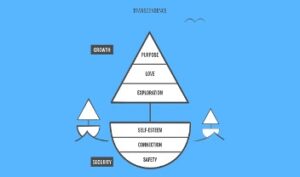
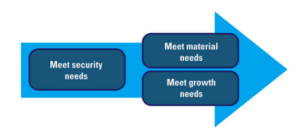
Using psychologist Scott Barry Kaufman’s ‘sailboat model’ (above), the RNBO ‘theory of change’ therefore becomes: help people meet their security needs so that they can meet their material needs. Additionally, in that process of collectively meeting their material needs, people meet their ‘growth needs’ (exploration, love, purpose).
After setting out our theoretical framework and theory of change, we dedicate the rest of the Handbook to ‘Putting RNBO into Practice’. This involves a guide through a five-stage journey of facilitation: Relating, Reconnecting, Raising Consciousness, Reimagining, and Responding

We provide a rationale, description, and, crucially, practical tools for each stage.
It is vital to emphasise that to the extent anything in this Handbook is original it is in its amalgamation and integration of myriad existing ideas and frameworks. We explicitly acknowledge this and point readers to very many websites where these ideas, frameworks, and practical tools can be found and more deeply explored.
The Handbook for Relational Needs-Based Organising can be downloaded here. We are planning a webinar event in September to launch the Handbook. Do get in touch if you would like to attend (info@rhizome.coop).